
Rebuilding Schneider Electric’s Retail Demand System into a Measurable Intelligence Engine
Business Problem
Schneider Electric had built a strong retail-driven model where customers could discover nearby electrical retailers through Google My Business (GMB) and directly initiate inquiries.
At a surface level, the system appeared to be working. Leads were coming in, retailers were receiving calls, and demand seemed active.
But once you looked closer, the cracks were obvious.
The system had no real visibility into what was actually happening beneath the lead layer.
Search data was fragmented. There was no clarity on what customers were searching for, how demand varied by geography, or which products were driving interest. Even basic questions around customer behavior and demand patterns couldn’t be answered with confidence.
At the same time, the most critical interaction point – the customer call – was being treated as an operational event, not a source of insight. Calls were neither tagged nor analyzed. There was no way to distinguish between a serious purchase inquiry and a casual query, no understanding of outcomes, and no record of how retailers were handling these conversations.
This created a deeper issue.
The system could generate demand, but it had no ability to interpret it.
Retailers, who were responsible for conversion, operated without any structured expectations. Response times varied, follow-ups were inconsistent, and performance depended entirely on individual effort rather than system design.
On top of this, the existing platform acted as a constraint rather than an enabler. It lacked flexibility, limited data visibility, and made it difficult to extract any meaningful business intelligence.
What this resulted in was a familiar but dangerous situation:
A system that looked active on the surface, but had no real mechanism to learn, improve, or scale.
Strategic Insight
The turning point was recognizing that GMB was not just a lead generation channel.
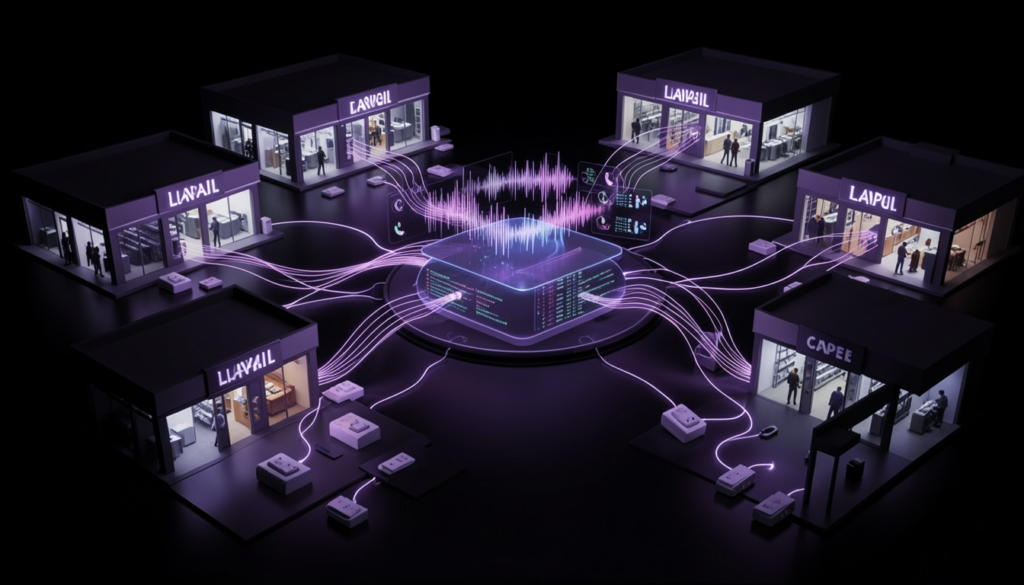
It was functioning as a distributed demand capture layer across a decentralized retail network.
Which meant the real problem wasn’t about increasing leads.
It was about the absence of a system that could:
- Understand demand
- Structure it
- And improve based on it
Once you see it that way, the solution is no longer campaign optimization.
It becomes system design.
Strategic Approach
Instead of trying to “improve performance,” the focus shifted to rebuilding the system across three core dimensions: intelligence, infrastructure, and behavior.
1. Making Demand Understandable (Intelligence Layer)
The first step was to fix the blindness in the system.
This meant defining what needed to be captured, not just more data, but the right kind of data.
Search patterns were structured to understand demand by location, keyword, and time. This made it possible to see where demand was emerging and how it was evolving.
More importantly, customer interactions were no longer treated as raw inputs. They were analyzed to extract intent, what the customer was actually looking for, which products were being asked about, and how conversations were progressing.
This shift turned demand from something abstract into something interpretable.
2. Rebuilding the Foundation (Technology Layer)
The next constraint was the platform itself.
The existing system was limiting visibility, flexibility, and the ability to scale insights. So the focus was not just on replacing it, but on clearly defining what the new system needed to enable.
This included:
- Real-time visibility into demand and performance
- Clean attribution between inquiry and outcome
- The ability to customize workflows as the system evolved
The transition had to be handled without disrupting ongoing lead flow, which meant balancing system redesign with operational continuity.
The outcome wasn’t just a better platform; it was a system that could actually support decision-making.
3. Structuring Retail Behavior (Behavior Layer)
One of the biggest realizations was that the system’s effectiveness depended as much on people as on technology.
Retailers were the last mile of conversion, but their behavior was completely unstructured.
So instead of assuming participation, the system began to guide it.
Structured communication loops were introduced using WhatsApp and system-triggered nudges. These weren’t just reminders; they were mechanisms to reinforce response discipline and follow-up behavior.
Over time, this created a shift:
- Faster responses
- More consistent follow-ups
- Greater accountability
The system began influencing behavior, not just tracking it.
4. Unlocking Call Intelligence
Customer calls were the most underutilized asset in the system.
By introducing AI-led analysis, calls were no longer just recorded; they were interpreted.
They could now be:
- Tagged based on intent (inquiry, interested, follow-up, etc.)
- Summarized for context
- Analyzed at scale to identify patterns
Conversations that were previously lost became a source of insight into:
- Customer needs
- Product demand
- Retailer effectiveness
5. Creating a Feedback-Driven System
The most important shift was closing the loop.
Earlier, the system looked like this: Lead → Retailer → Unknown outcome
Now it has evolved into: Demand → Interaction → Insight → Improvement
Every part of the system began feeding into the next.
This made it possible to not just generate demand, but to learn from it and continuously improve the system
Execution Overview
My role was not limited to analysis or planning; it involved owning the system end-to-end.
This included:
- Leading the platform transition while maintaining operational continuity
- Defining feature requirements based on business needs, not tool capabilities
- Driving retailer engagement and participation
- Building frameworks to interpret and use data effectively
- Acting as the central layer aligning internal teams, external partners, and on-ground execution
Business Impact
The impact was not just in numbers, but in how the system functioned.
Lead flow became more consistent, but more importantly, lead handling improved significantly. Retailers were more responsive, follow-ups became structured, and customer interactions became more meaningful.
For the first time, the business had visibility into what customers were actually asking for and how demand was distributed across products and regions.
Decision-making shifted from assumptions to signals.
And the system moved from being a passive lead generator to an active demand intelligence engine.
Key Lessons
- A system that generates demand without understanding it will always plateau
- The biggest insights are often hidden in unstructured data, like conversations
- Technology alone doesn’t fix systems; behavior design does
- Attribution is not a dashboard feature; it’s a structural capability
- Real growth comes from systems that learn, not just execute